

Vendor trade spend management is the process of tracking, reconciling, and optimizing the promotional funding vendors provide to retailers — discounts, buy-downs, display credits, and similar deals — to make sure every dollar owed is actually collected and every promotion is judged on real profitability, not guesswork. In traditional CPG retail, this is a mature discipline with dedicated software. In cannabis retail, it’s still mostly run on spreadsheets, which means a meaningful share of the credits vendors owe dispensaries never actually get collected.
Here’s what trade spend management actually involves, why cannabis retail makes it harder than it needs to be, and what fixing it looks like in practice.
What Is Trade Spend Management?
In consumer retail broadly, trade spend is the funding a vendor puts up to help move their product through a retailer — a discount on a case order, a buy-one-get-one credit, a display fee, a promotional markdown the vendor agrees to fund in part or in full. Industry estimates put trade spend at somewhere around 10–20% of a typical vendor’s revenue — it’s a major line item, not a rounding error.
Trade spend management is the discipline of tracking which promotions ran, what they cost, what they actually returned, and — critically — making sure the retailer collects every credit the vendor agreed to fund. Done well, it’s a feedback loop: better tracking leads to better-negotiated terms next cycle, which leads to more profitable promotions.
Done manually, it’s usually a one-way leak. Industry research on traditional CPG trade spend suggests a substantial share of promotions turn out to be unprofitable once real costs are accounted for — largely because most companies can’t measure performance precisely enough to know until well after the fact.
Why Trade Spend Is Harder to Track in Cannabis Retail
Traditional CPG companies have had decades to build trade promotion management (TPM) software, dedicated finance teams, and standardized vendor agreements. Cannabis retail doesn’t have that infrastructure yet — for structural reasons, not because operators are behind.
No Standardized Tools Built for Cannabis Vendor Terms
Mainstream TPM software is generally built for national CPG brands with big-box retail relationships. Cannabis vendor agreements — often store-by-store, sometimes verbal or informal, frequently renegotiated — don’t map cleanly onto those tools, so most cannabis operators are left without a category-specific option.
Vendor Credits Get Buried in POS Exports
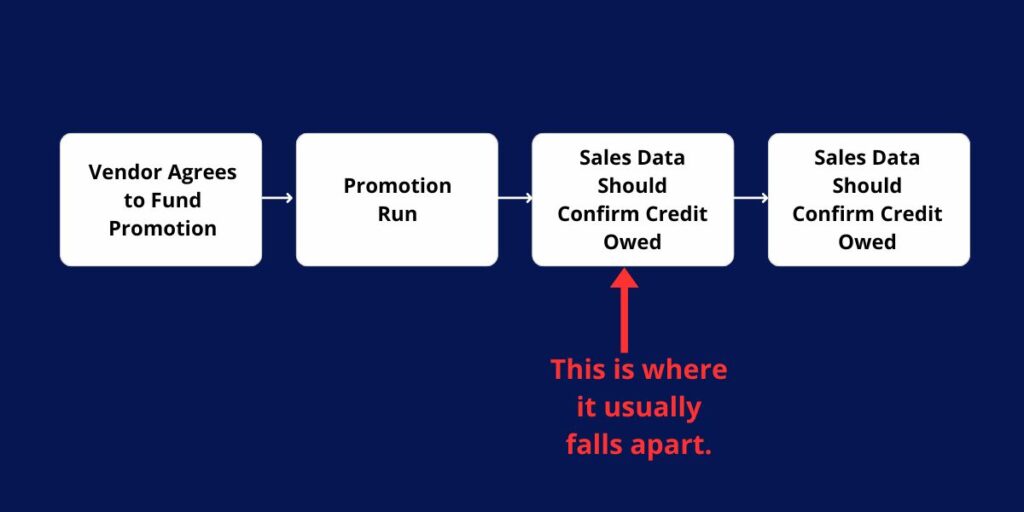
Your POS records the transaction-level sales data that proves what a promotion earned, but it wasn’t built to track vendor-side commitments, invoice them, or flag when a credit hasn’t been collected. That translation step — from raw sales data to “here’s what this vendor owes us” — is almost always manual.
Multi-Store Complexity Multiplies the Problem
A single-store operator can (barely) keep vendor deals straight in a spreadsheet. Add a second, third, or eighth location, each potentially with slightly different vendor terms, and the manual version of this process stops scaling — not gradually, but all at once.
The Cost of Manual Trade Spend Tracking
When vendor credits are tracked by hand, three things tend to go wrong quietly:
- Credits get missed. Without a system flagging what’s owed, easy-to-overlook credits simply don’t get invoiced. Nobody decided not to collect them — they just fell through the cracks between spreadsheet tabs.
- Negotiations happen from memory. Without a clean historical record, the next vendor conversation runs on “I think that promotion did well,” not a specific, defensible number.
- Nobody actually knows which promotions are profitable. Parsing thousands of individual POS transactions by hand to isolate one vendor’s promotional ROI is, practically speaking, not something a spreadsheet is built to do at scale — so operators end up repeating whatever ran last time, profitable or not.
None of this is a discipline problem. It’s a tooling problem — the manual process breaks down at a scale that has nothing to do with how careful your team is.
What Automated Trade Spend Management Looks Like
A dedicated system closes the loop that spreadsheets can’t:
Every Promotion Tied to Real POS Data Instead of exporting and reconciling by hand, promotional performance is calculated automatically from live transaction data — accurate by default, not by heroic effort.
Vendor Credits Calculated and Tracked Automatically The system serves as the system of record: what was promised, what was earned, what’s been invoiced, and what’s still outstanding — visible without anyone rebuilding a spreadsheet.
A Permanent, Searchable History Every past promotion, by vendor, by store, by product — queryable when it’s time to plan next month or renegotiate terms, instead of buried in last year’s files.
Leverage in Vendor Conversations Walking into a vendor meeting with a specific, defensible number — “this promotion drove X in incremental sales at Y margin” — changes the negotiation. Memory doesn’t do that. A record does.
This is precisely what Dispensary Promotions Management is built to handle: automated vendor credit calculation, POS-integrated promotional insights, and a permanent record your team can use for both day-to-day operations and vendor negotiations.
FAQ
What is trade spend in the cannabis industry? Trade spend refers to the funding cannabis vendors and brands provide to dispensaries to support promotions — discounts, buy-downs, bundle deals, and similar arrangements — intended to drive sales of their products. It functions similarly to trade spend in traditional CPG retail, but without the mature tracking infrastructure that industry has built up over decades.
Why don’t cannabis dispensaries use standard trade promotion management (TPM) software? Most TPM platforms are built for large, established CPG brands with standardized big-box retail agreements. Cannabis vendor relationships tend to be more localized and variable, so mainstream TPM tools generally don’t fit without significant workarounds — leaving a gap that cannabis-specific tools are only now starting to fill.
How much revenue does trade spend typically represent? In traditional CPG retail, industry estimates put trade spend at roughly 10–20% of a vendor’s revenue. Comparable cannabis-specific benchmarks are less established, but the underlying dynamic — vendors funding promotions to drive shelf movement — is the same.
What’s the fastest way to start tracking vendor trade spend accurately? Connect a system directly to your POS so promotional performance and vendor credits calculate automatically, rather than starting a new spreadsheet. Dispensary Promotions Management does this out of the box — no manual reconciliation required.